
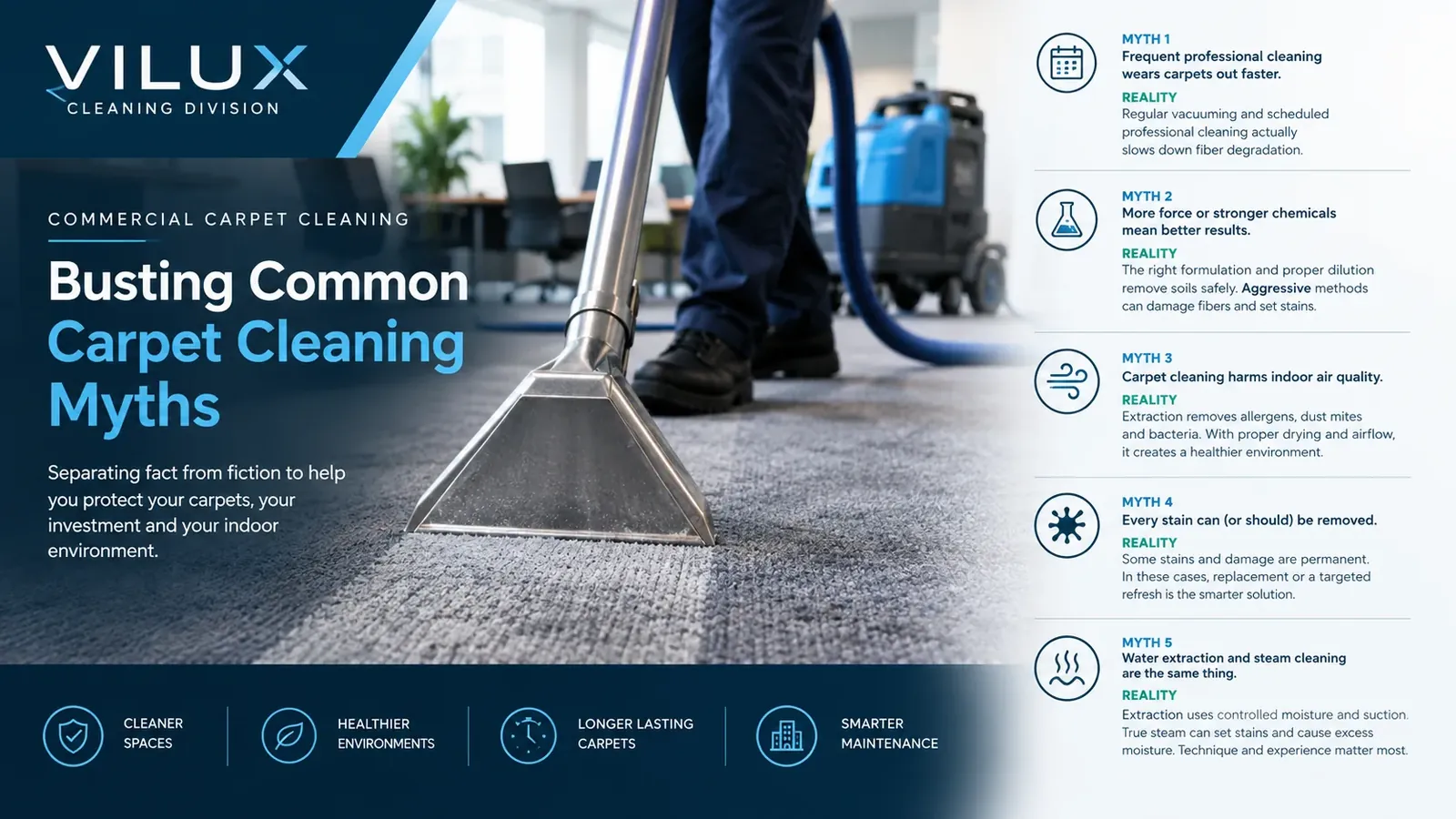
Over nearly a decade of hands-on work with commercial carpets—from high-traffic offices to hospitality venues—I’ve encountered persistent misunderstandings that lead businesses to either overlook essential maintenance or pursue ineffective approaches. These myths often stem from outdated advice, DIY experimentation, or conflating carpet cleaning with upholstery or hard-surface methods. Addressing them isn’t just about correcting misinformation; it’s about helping clients make informed decisions that genuinely extend the life and appearance of their flooring investments. Let’s walk through the most common misconceptions I’ve seen, grounded in what actually works in the field.
One widespread belief is that frequent professional cleaning accelerates carpet wear. In reality, the opposite is true: grit and particulate matter act like sandpaper on fibers when left embedded. I’ve observed that clients who combine regular vacuuming (using equipment with adequate suction and filtration) with scheduled professional extractions see significantly slower fiber degradation. This aligns with basic textile science—abrasive soils break down piles over time, while consistent removal interrupts that cycle. In my experience, this compounding effect keeps furniture looking fresh for years; skipping cleanings doesn’t preserve carpets—it invites premature deterioration.
Another myth suggests that cleaning success depends primarily on applying more force or using stronger chemicals. This is dangerously misleading. Using an overly aggressive agent (like high-pH solutions on wool blends) or excessive agitation can fray fibers, create permanent texture changes, or even set stains deeper—as noted in industry research on improper chemical application. Conversely, the right formulation matters immensely. Our in-house developed shampoo, for instance, targets common commercial soils like tracked-in grease and mud with specific builders (soda ash, sodium metasilicate) while remaining safe on delicate materials at proper dilution ratios. For sensitive areas such as Persian rugs or suede accents, we reduce chemical concentration and rely on gentler agitation—proof that precision, not brute force, drives results.
Concerns about carpet cleaning harming indoor air quality also persist, likely from witnessing temporary dampness post-service. While it’s true that carpets release moisture during drying (influenced by ventilation, humidity, and material thickness), the extraction process itself removes deeply embedded allergens, dust mite debris, and bacteria that vacuums leave behind. Well‑executed cleaning lowers airborne particulates over time by removing allergen reservoirs rather than creating them. The key is ensuring adequate airflow during the 3-4 hour drying window (though this varies by job), not avoiding cleaning altogether. Properly dried carpets contribute to healthier environments, not the reverse.
Perhaps the most important myth to dismantle is the idea that every stain can—or should—be completely erased through cleaning alone. Honest assessment requires recognizing limits. For example, when contaminants like urine or fecal matter penetrate deeply into the carpet underfelt over extended periods (as seen in a challenging case involving prolonged pet exposure), surface cleaning may lift visible residue but struggle to fully eliminate associated odors trapped below. Similarly, years of unprotected chair legs grinding against carpet pile create irreversible wear patterns—areas that appear lighter or shiny aren’t dirty; they’re physically damaged, and no amount of cleaning can restore the original pile height. In such scenarios, recommending replacement isn’t an upsell; it’s pragmatic stewardship. Pushing endless cleaning on irreversibly compromised areas wastes resources when a targeted refresh of the zone makes more sense.
Finally, there’s frequent confusion between water extraction and steam cleaning—a distinction central to our methodology. Our equipment injects and immediately extracts heated or ambient-temperature solution to suspend and remove soils, relying on controlled moisture levels and powerful suction. True steam cleaning (using vapor-only systems) risks setting protein-based stains, overwhelming delicate backings with heat, and leaving residual moisture that promotes mildew. Confusing the two overlooks why extraction excels at lifting embedded grime without the drawbacks of saturation—a nuance confirmed by years of adjusting techniques based on fiber type, soil load, and environmental conditions. Performance hinges on correct application, not machine size alone; well-maintained mid-capacity extractors often outperform larger, poorly operated units through consistent spray-recovery balance.
These insights aren’t theoretical—they emerge daily from assessing real-world conditions, adapting processes to specific fabrics and soils, and prioritizing transparent communication with clients about achievable outcomes. When you partner with a provider who values this depth of understanding, carpet care shifts from a routine task to a strategic preservation effort. To learn how our professional Commercial Carpet Cleaning approach addresses your unique space—factoring in fiber type, traffic patterns, and maintenance history—feel free to get in touch. We’ll discuss your goals openly and outline a plan built on what genuinely works, not myths.
If you'd like to discuss your specific situation, get in touch with our team and we'll be happy to help.